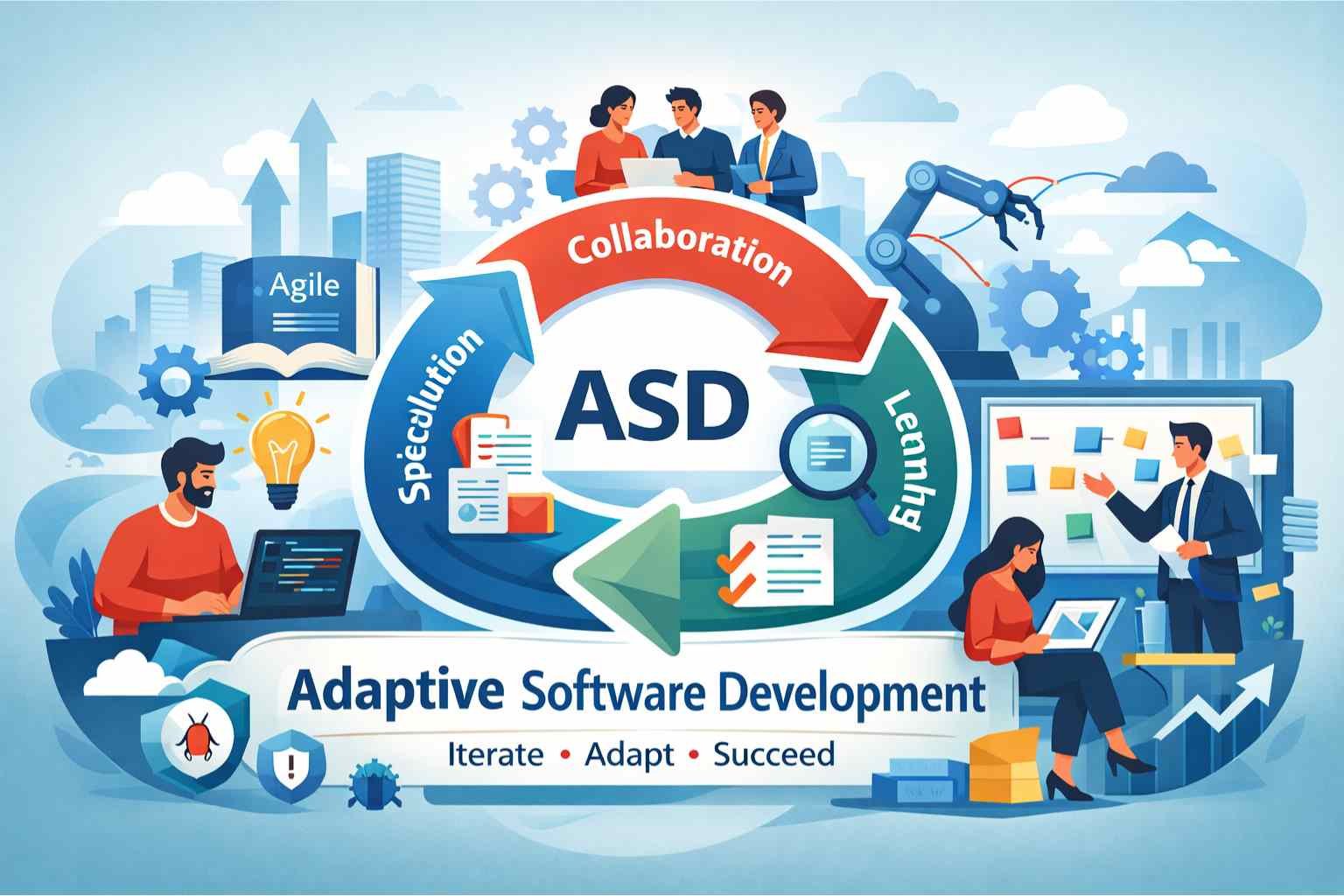
What Is Adaptive Software Development Explained
Meta description: Learn what is adaptive software development, how it works, its phases, benefits, challenges and when to use it in complex software projects.
Adaptive software development is an agile methodology designed for complex and fast-changing software projects. It focuses on collaboration, continuous learning, and flexible planning instead of rigid documentation and fixed requirements.
Rather than trying to predict every detail at the start, teams working with adaptive software development evolve their product through short cycles, feedback and real-time adjustments.
This approach makes it especially useful in environments where requirements shift frequently and uncertainty is part of the process.
The mindset behind adaptive software development
Adaptive software development is built on the belief that software projects are rarely predictable. Markets change, technologies evolve, and user expectations shift. Traditional plan-driven models struggle in such environments because they depend on detailed upfront planning.
ASD embraces uncertainty. It assumes that change will happen and designs the development process around learning and adjustment. Teams are encouraged to experiment, gather feedback and refine the product as they move forward. This mindset turns change from a disruption into a strategic advantage.
Origins rooted in complex systems thinking
Adaptive software development emerged in the 1990s through the work of Jim Highsmith and Sam Bayer. It evolved from rapid application development and later became aligned with the broader agile software development movement. Highsmith’s work focused on managing complex systems where outcomes cannot be fully predicted at the beginning.
Unlike linear models such as Waterfall, ASD treats software development as a dynamic system. It recognizes that people, technology, and business goals interact in ways that require flexibility. This systems thinking approach still influences many modern agile methodologies.
The three-phase rhythm that drives ASD
At the heart of adaptive software development lies a repeating cycle of speculation, collaboration, and learning. These phases replace traditional rigid project stages.
Speculation as adaptive planning
Speculation does not mean guessing. It means planning with the understanding that plans will evolve. Teams define a clear mission, identify high-level requirements, and outline release cycles. Instead of locking every feature upfront, they create room for refinement.
For example, a startup building a fintech app might begin with a broad goal of enabling peer-to-peer payments. Specific features, security layers, and interface decisions are allowed to evolve as user feedback comes in.
Collaboration as the engine of delivery
Collaboration is central to ASD. Developers, stakeholders, testers, and business leaders work closely together. Decision-making authority is often decentralized, empowering teams to respond quickly.
In adaptive software development, communication is continuous. Teams share ideas, challenge assumptions respectfully, and solve problems collectively. This level of engagement improves product quality and reduces misunderstandings.
Learning as a structured feedback loop
Learning is not an afterthought. It is built into every iteration. Teams conduct technical reviews, gather customer feedback, and reflect on performance. This continuous learning approach strengthens both the product and the team.
Post-iteration reviews often reveal insights that reshape priorities. A feature that seemed essential may be simplified or removed after real-world testing. The learning phase ensures that improvements are systematic rather than accidental.
Core principles shaping adaptive delivery
Adaptive software development relies on several principles that guide daily work.
Emphasis on iterative development ensures that software is delivered in small increments. Each release provides working functionality, reducing risk and allowing earlier validation.
Risk management is proactive. Instead of addressing risks at the end, teams identify uncertainties early and adjust plans accordingly.
Team empowerment fosters accountability. When teams have ownership, they respond faster and make better decisions. This is particularly important in complex projects where central control can slow progress.
Continuous testing integrates quality assurance into every stage. Testing is not delayed until final delivery. It evolves alongside development.
Position within the agile landscape
Adaptive software development is often associated with agile methodologies, but it has its own distinct identity. While Scrum organizes work into time-boxed sprints and Kanban emphasizes workflow visualization, ASD centers on adaptability and learning in highly complex environments.
Compared to Waterfall, ASD offers greater flexibility. Waterfall follows a sequential process where requirements are fixed before development begins. ASD accepts that requirements may change and builds processes around that reality.
Scrum and ASD share similarities in iterative cycles and team collaboration. However, ASD places stronger emphasis on uncertainty and adaptive planning at a strategic level rather than strict sprint structures.
Scenarios where ASD proves most effective
Adaptive software development is particularly valuable in industries experiencing rapid change. Technology startups, research-driven organizations, and innovative product teams often benefit from its flexibility.
Consider a company developing artificial intelligence tools. Algorithms may need repeated refinement based on data performance. Market expectations may shift as competitors release new features. In such situations, a rigid development plan can limit responsiveness.
Large enterprises also use ASD when managing digital transformation initiatives. When multiple departments are involved and requirements evolve during implementation, adaptability becomes essential.
Challenges that demand careful management
Despite its strengths, adaptive software development is not effortless to implement. It requires skilled teams capable of self-organization. Without strong communication and accountability, flexibility can turn into confusion.
Frequent changes may create scope creep if priorities are not clearly managed. Leaders must maintain alignment with strategic goals while allowing room for iteration.
Customer involvement is another critical factor. ASD depends on consistent stakeholder engagement. When feedback is delayed or inconsistent, the learning cycle weakens.
Clear governance structures and disciplined retrospectives help prevent these risks from undermining progress.
Practical steps for implementing ASD in real teams
Successful adoption of adaptive software development begins with cultural readiness. Teams must embrace openness, trust and shared responsibility. Leadership plays a key role in supporting decentralized decision-making.
Next, establish short iteration cycles with clear objectives. Each cycle should deliver measurable outcomes, even if small. This maintains momentum and builds confidence.
Invest in collaboration tools that support transparency. Version control systems, automated testing frameworks and shared communication platforms strengthen coordination.
Regular reflection sessions are essential. After each cycle, teams should analyze results, document lessons learned and adjust strategies. This reinforces the learning-driven nature of ASD.
Impact on project outcomes and business agility
Organizations that apply adaptive software development effectively often experience improved responsiveness and faster time to market. By delivering incremental value, they reduce the risk of investing heavily in features that customers do not need.
Employee engagement tends to increase as well. Empowered teams feel more connected to outcomes. This improves morale and retention, especially in knowledge-intensive industries.
From a business perspective, ASD enhances strategic agility. Companies can pivot when market conditions change without abandoning months of rigid planning.
Modern relevance in the era of continuous innovation
In today’s technology landscape, change is constant. Cloud computing, artificial intelligence and evolving customer expectations demand flexibility. Adaptive software development aligns naturally with these conditions.
DevOps culture and continuous delivery pipelines complement ASD principles. Both emphasize rapid feedback, automation and iterative improvement.
Even though newer agile frameworks have emerged, the core philosophy of adaptive software development remains relevant. Its focus on learning and collaboration continues to influence modern project management approaches.
Balancing structure and freedom
Adaptive software development does not eliminate structure. It replaces rigid structure with flexible guidance. Clear mission statements, defined release goals and accountability mechanisms provide stability.
The balance between freedom and discipline determines success. Too much rigidity undermines adaptability. Too little structure creates chaos. Effective teams find equilibrium through experience and reflection.
This balance is particularly important in regulated industries such as healthcare or finance, where compliance requirements must coexist with innovation.
A strategic choice for complex environments
Adaptive software development represents a strategic choice rather than a universal solution. Projects with stable, well-defined requirements may not require its full flexibility. In such cases, simpler agile methods or even traditional approaches may suffice.
However, when uncertainty is high and complexity dominates, ASD offers a practical framework for navigating change. It turns unpredictability into a manageable component of the development process.
Organizations that commit to its principles often discover that adaptability becomes part of their broader culture, extending beyond software into decision-making and leadership.
Conclusion
Adaptive software development provides a flexible, learning-driven framework for managing complex software projects. By combining iterative development, collaboration and structured reflection, it enables teams to respond effectively to change.
Its relevance continues in modern agile environments where adaptability is not optional but essential. When applied thoughtfully, adaptive software development strengthens both product outcomes and organizational resilience.
FAQs
Is adaptive software development the same as Agile or just a part of it?
Adaptive software development is considered part of the broader agile movement, but it has its own philosophy. It places stronger emphasis on learning and adapting in highly complex projects rather than following a fixed sprint structure.
Can small teams use adaptive software development effectively?
Yes, small teams can use it well, especially when working on innovative or uncertain projects. It works best when team members communicate openly and are comfortable making shared decisions.
Does adaptive software development require specific tools?
There are no mandatory tools, but collaboration platforms, version control systems and automated testing tools make the process smoother. The real focus is on teamwork and feedback, not software tools.
How is adaptive software development different from Scrum in daily work?
Scrum follows structured sprints and defined roles, while adaptive software development is more flexible in planning and execution. It allows teams to reshape plans more fluidly as they learn.
When is adaptive software development not the right choice?
It may not suit projects with fixed requirements and strict regulatory constraints. In stable environments where change is minimal, simpler or more structured methods can be more efficient.
— End of FAQs —